Hero365 vs. ServiceTitan: Which HVAC Business Management Software Actually Fits Your Shop?
ServiceTitan charges $600-900/user/month — but doesn't track refrigerant logs or answer your after-hours calls. Here's an honest, feature-by-feature breakdown of Hero365 vs ServiceTitan for HVAC shops with 1-15 employees.

You’ve probably heard the pitch a dozen times: “ServiceTitan is the industry standard.” And honestly, for a 50-truck operation doing $20M a year, it might be. But you’re running a 3-to-12 person HVAC company. You’re pulling $800K to $3M. And you’re paying — or being asked to pay — $600-900 per user per month for software that doesn’t even track your refrigerant logs.
Something about that math doesn’t add up. So we built Hero365 MEP Pro for shops exactly like yours. But we’re not going to just tell you we’re better and call it a day. Here’s an honest, feature-by-feature Hero365 vs ServiceTitan HVAC comparison so you can decide for yourself.
Hero365 vs ServiceTitan HVAC: Pricing That Won’t Eat Your Margins
This is the elephant in the room, so we’ll start here.
ServiceTitan charges per user. $600-900/month, per user. If you’ve got an office manager, two techs, and yourself on the system, you’re looking at $2,400-3,600/month. That’s $28,800-43,200 a year — before you’ve bought a single capacitor.
Hero365 charges per business. Not per user. Our Starter plan is $42-50/month. Professional is $125-150/month. Even our Enterprise tier — which includes everything — runs $417-500/month total. Add as many users as you need. The price doesn’t change.
Here’s what that looks like in practice:
| Hero365 (Professional) | ServiceTitan (4 users) | |
|---|---|---|
| Monthly cost | $125-150 | $2,400-3,600 |
| Annual cost | $1,500-1,800 | $28,800-43,200 |
| Per-user fees | None | $600-900/user/mo |
| Contract required | No | Yes (typically annual) |
That annual difference? It’s roughly the cost of a new van wrap and a set of recovery equipment. Or, you know, actual profit.
EPA 608 Compliance and Refrigerant Tracking — The Feature ServiceTitan Doesn’t Have
Here’s where it gets interesting. If you’re doing any work with refrigerants — and if you’re in HVAC, you are — you need to track every pound. EPA Section 608 isn’t a suggestion. One failed audit can mean fines of $44,539 per day per violation. We’ve talked to shop owners who track this stuff in spiral notebooks. Some use a shared Google Sheet that hasn’t been updated since last August.
ServiceTitan doesn’t have built-in refrigerant logging or EPA compliance tracking. Full stop. You’d need a workaround, a third-party integration, or — most likely — you’d keep doing it on paper and hope for the best.
Hero365 MEP Pro has digital refrigerant logging baked in. Your techs log type, quantity, and equipment serial number right from the job screen on their phone. It auto-generates the compliance reports you’d need if an auditor showed up tomorrow morning. We wrote a whole guide on tracking refrigerant usage and staying EPA compliant without spreadsheets — worth a read if this is a pain point for you (and it should be).
After-Hours Calls: The $500 Jobs You’re Losing Tonight
Picture this: it’s 11:30 PM on a Tuesday in July. Someone’s AC just died. Their house is 89°F. They call three HVAC companies. Two go to voicemail. One picks up.
Who gets the $500-800 emergency call?
About 40% of calls to small contractors go unanswered after hours. That’s not a guess — it’s a pattern we see across the industry. And every missed call is revenue walking straight to your competitor.
ServiceTitan has some call-handling features, but they’re built around the assumption that you have dispatchers on staff. Most shops under 15 people don’t have a dedicated dispatcher, let alone one working overnight.
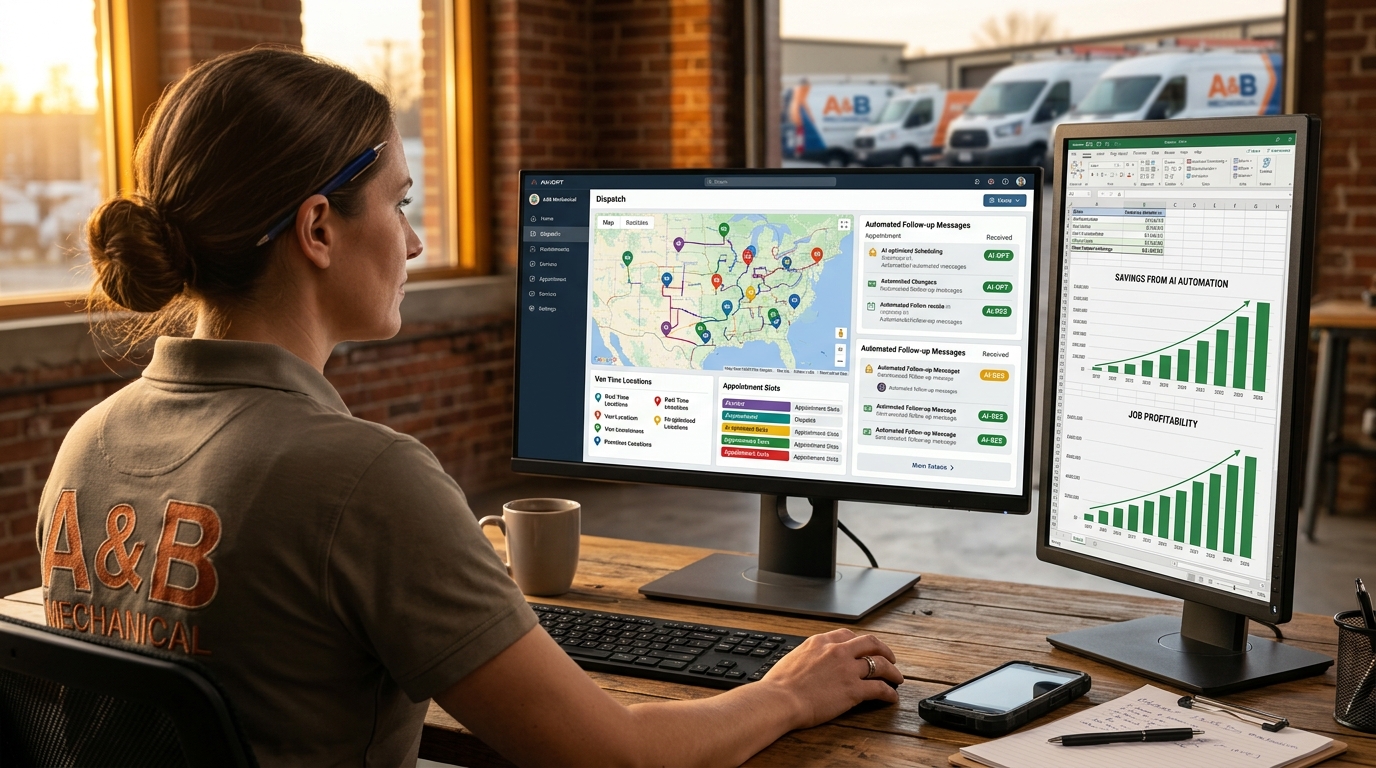
Hero365’s AI voice agent picks up every call — 2 AM, Sunday morning, Christmas Eve. It doesn’t just take a message. It books the appointment, confirms with the customer, and slots it into your smart scheduling system. Shops using it are booking 40%+ more jobs simply because they’re answering the phone when no one else does. We broke down the full strategy in our post on handling after-hours HVAC calls without hiring a full-time dispatcher.
HVAC Management Software Comparison: Feature by Feature
Enough narrative. Here’s what matters, side by side:
| Feature | Hero365 MEP Pro | ServiceTitan |
|---|---|---|
| Scheduling & dispatch | ✅ AI-powered | ✅ Yes |
| CRM & customer history | ✅ Yes | ✅ Yes |
| Invoicing & payments | ✅ Yes | ✅ Yes |
| Estimates & proposals | ✅ Yes | ✅ Yes |
| Refrigerant logging (EPA 608) | ✅ Built-in | ❌ No |
| EPA compliance reports | ✅ Auto-generated | ❌ No |
| AI voice agent (24/7) | ✅ Included | ❌ No (needs CSRs) |
| Route optimization | ✅ Yes | ✅ Yes |
| Seasonal demand forecasting | ✅ AI-driven | ❌ Limited |
| Per-user pricing | ❌ Flat per-business | ✅ $600-900/user/mo |
| Contract required | ❌ No | ✅ Annual |
| Mobile app for techs | ✅ Yes | ✅ Yes |
ServiceTitan wins on brand recognition and depth of integrations with enterprise tools. We won’t pretend otherwise. But if you look at what a 5-to-10 person HVAC shop actually needs day-to-day, Hero365 covers it — and adds trade-specific features ServiceTitan simply doesn’t offer.
Seasonal Demand: The Problem Nobody Talks About
You know the cycle. June through September, your phone won’t stop ringing. You’re turning down work. You’re running crews six days a week. Then November hits and suddenly you’re wondering how to make payroll.
Most HVAC business software treats every week the same. ServiceTitan gives you reports on what happened. But it doesn’t tell you what’s coming.
Hero365 uses AI-driven demand forecasting built on your historical data, local weather patterns, and regional trends. It flags when a slow stretch is approaching — early enough to run a maintenance campaign or push tune-up specials through autopilot outreach. And when the summer rush is about to hit, it helps you plan crew schedules weeks ahead instead of scrambling on Monday morning.
A $3,500-5,000 residential HVAC install has solid margins — but only if your crew isn’t sitting idle for three weeks between jobs. Forecasting is the difference between “good year” and “great year.”
So Who Should Pick ServiceTitan?
We’re being honest here. ServiceTitan makes sense if:
- You’re running 30+ trucks and need enterprise-level reporting
- You have a full-time office staff handling dispatch, CSR, and accounting
- You’re already locked into their ecosystem with integrations you can’t easily replace
- Your annual revenue is north of $10M and per-user pricing is a rounding error
If that’s you, ServiceTitan is a solid platform. No argument.
But if you’re a 1-to-15 person HVAC, plumbing, or electrical shop — the kind where the owner is still running calls, doing estimates, and checking invoices from the truck — ServiceTitan is almost certainly overkill. And the price tag proves it.
Switching Doesn’t Have to Be Painful
We hear this a lot: “I know I’m overpaying, but switching sounds like a nightmare.” Fair. But Hero365 was built by people who understand that you can’t shut down for a week to migrate software. Our onboarding pulls in your customer data, job history, and scheduling — and most shops are fully running within a few days, not months.
You can run the numbers yourself with our cost calculator to see exactly what you’d save. Or check out MEP Pro to see the full feature set built specifically for HVAC, plumbing, electrical, and refrigeration contractors.
If you’re on the fence, try this: add up what you’re paying ServiceTitan this year. Then ask yourself if you’re actually using $30,000+ worth of features — or if you’re paying enterprise prices for a small-business operation. The answer usually makes the decision pretty clear.