Gas Safety Certificate Software vs Standalone CP12 Apps: What Heating Engineers Actually Need in 2026
Standalone CP12 apps fill in the form. But most Gas Safe engineers need the whole loop — booking, certifying, chasing renewals, getting paid. Here's what actually matters in 2026.
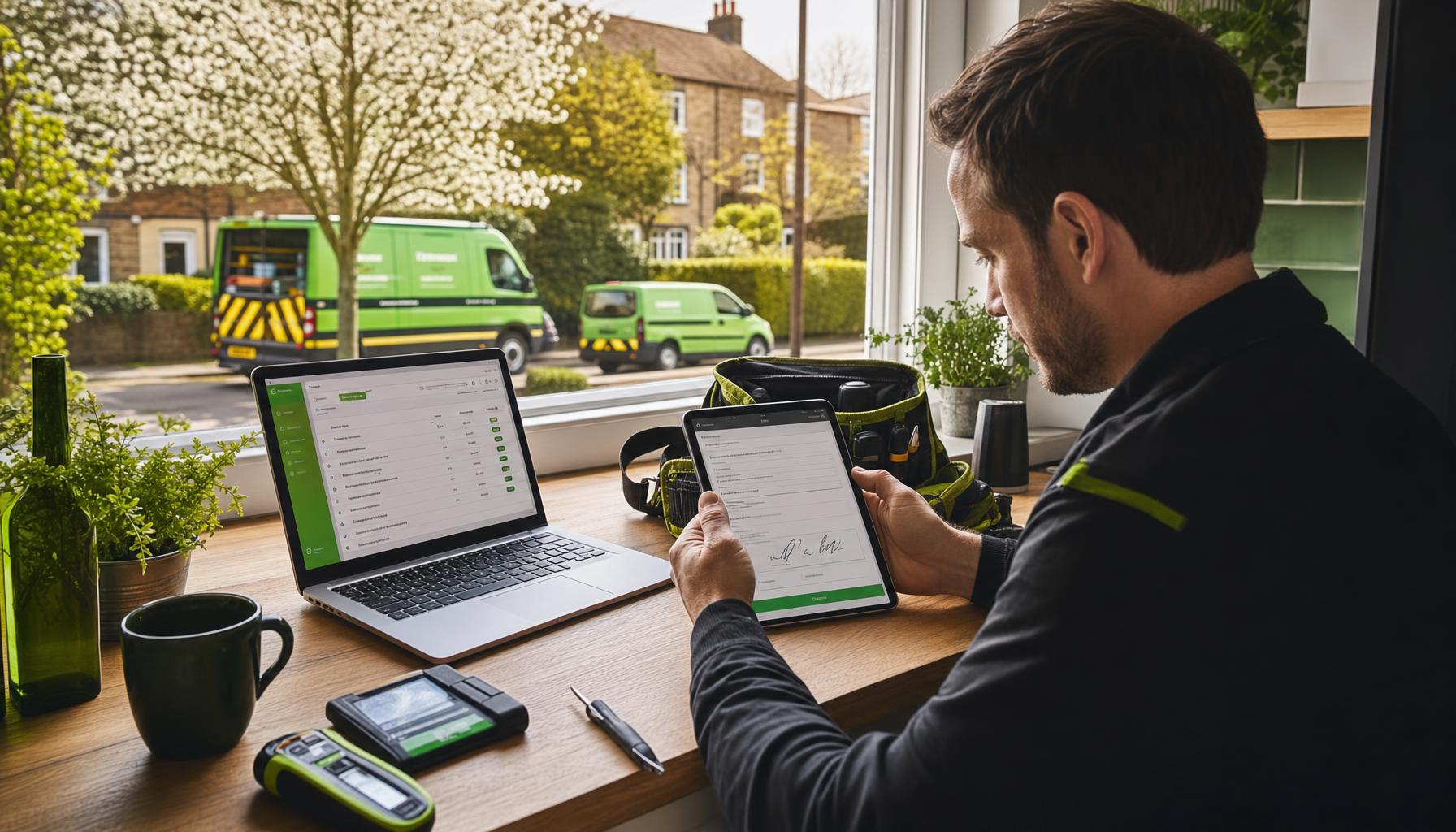
You’ve just finished a landlord gas safety check on a tired combi in a cold flat above a chippy. Boiler’s fine, flue’s fine, all four appliances passed. Now you’re stood in the hallway trying to fill in a CP12 on an app that freezes every time the signal drops — because of course the signal drops, you’re in a basement flat with brick walls a foot thick.
Sound familiar? This is the daily reality for most Gas Safe registered engineers, and it’s exactly why the “which CP12 app should I use” question keeps coming up in every heating engineers’ WhatsApp group and forum thread. But the real question isn’t which app. It’s whether a standalone CP12 app is even the right shape of tool for how your business actually runs in 2026.
Gas safety certificate software: what’s actually different from a CP12 app
Here’s the distinction that gets lost in most comparisons. A standalone CP12 app does one job — it lets you fill in a landlord gas safety record on your phone instead of a paper pad. That’s it. You still need something else to book the job, remind the tenant, invoice the landlord, chase the payment, and keep a record of when the next check is due.
Proper gas safety certificate software does all of that in one place, because a CP12 was never really the job — the job is the whole cycle: booking, doing the work, certifying it, getting paid, and coming back in 12 months without anyone having to remember to chase it.
If you’re a one-man band doing three or four landlord checks a week, a bare-bones CP12 app might feel like enough. But most Gas Safe engineers we talk to are also fitting boilers, running service contracts, and juggling emergency callouts — and that’s where a standalone certificate app starts showing its age. You end up with the CP12 in one app, the diary in another, invoices in a spreadsheet, and a landlord ringing you three months late asking where their certificate went.
The compliance bit you can’t skip: Gas Safe and CP12 record-keeping
Any Gas Safe engineer software worth having needs to nail the basics of the compliance side before it does anything clever. That means:
- Gas Safe ID capture on every certificate, tied to the engineer who actually carried out the check — not whoever happened to be logged in.
- Full appliance-by-appliance detail — make, model, location, flue type, and pass/fail on each one, not a single tick box for “boiler checked.”
- Automatic 12-month renewal tracking, so landlords (and you) get a nudge well before the certificate lapses rather than a panicked call the week it expires.
- A permanent, retrievable record — because if a tenant or the HSE ever asks for proof, “I think it’s on an old phone somewhere” isn’t an answer anyone wants to give.
We went into the legal side of this in more detail in our piece on CP12 landlord gas safety certificates and what’s actually required — worth a read if you’re not 100% sure what a lapsed certificate actually exposes you and the landlord to.
Where the UK’s CP12 apps land — and where they stop
There’s decent choice out there, and it’s worth being honest about who does what well.
Tradify is straightforward job management with quotes, scheduling, and invoicing bolted together, and it’s priced clearly — Lite at £34, Pro at £37, and Plus at £44 per user per month, straight from their own pricing page. Fine if you want simple job tracking and don’t mind per-user costs climbing as you take on staff.
Commusoft goes deeper into the heating and plumbing side specifically, with CP12 and Gas Safe certificates built into the job record rather than bolted on. Solid choice for a mid-sized heating firm, though pricing is quote-only so you’ll need to ring round.
ServiceM8 is a lighter job management app aimed at small trade businesses generally, not gas-specific, and again it’s quote-only on price.
Joblogic and Simpro lean towards asset management and planned maintenance for bigger contractors — more machinery than most 3-10 person heating firms need, and both are quote-based too.
Payaca sits in a different lane entirely, built for renewables — solar, heat pumps, batteries, EV chargers — so it’s not really a CP12 tool at all unless heat pumps are your bread and butter.
None of that’s wrong. But notice the pattern: every one of them is either a certificate tool with job management bolted on, or a job management tool with a certificate feature bolted on. Whichever way round it goes, someone still has to manually chase the landlord for payment, manually book the renewal check, and manually follow up when a tenant doesn’t answer the door.
What Gas Safe engineers actually need: the whole loop, not another app
Picture this. It’s Tuesday, 7am, and you’ve got six jobs on the board — two landlord CP12s, a boiler service, and an emergency no-heat call that came in overnight. Right now, that emergency call either went to voicemail or woke you up. And whoever’s certificate is due next month? Nobody’s thought about it yet.
That’s the gap Hero AI is built to close. It’s not another CP12 app sat alongside your existing kit — it’s the AI staff that runs the whole loop around the certificate itself:
- Answers the call at 11pm when a tenant’s boiler’s packed in, books the job straight onto your diary, and flags it as gas-safety-related so you turn up with the right paperwork already loaded.
- Drafts your Good/Better/Best quote from a voice note after the visit, in under a minute, instead of you typing it out from memory that evening.
- Tracks CP12 renewal dates automatically and nudges the landlord — and you — well before the 12 months are up, so it never becomes a compliance scramble.
- Chases the invoice once the certificate’s issued, so the landlord who’s “definitely going to sort it next week” actually gets sorted this week.
- Routes your day so the two CP12 checks and the boiler service aren’t sending you back and forth across town for no reason — engineers using it see 10-15% less drive time.
That’s the difference between a certificate app and gas safety certificate software that actually earns its keep. One fills in a form. The other runs the business around the form.
What to actually check before you commit
Whichever direction you’re leaning, ask these before signing up to anything:
- Does it capture Gas Safe ID and full appliance detail on every CP12, or just a summary?
- Does it chase renewals automatically, or is that still on you?
- Is pricing per-user, and what does that look like once you take on a second engineer?
- Does it handle the booking and the invoicing, or just the certificate?
- Can a landlord or tenant reach you after hours without it going to voicemail?
If your diary and your invoicing are already sorted and all you’re missing is a decent digital CP12, a standalone app like Tradify or ServiceM8 will probably do the job — though the per-user pricing is worth doing the maths on as you grow. If you’re finding the certificate is the easy bit and everything around it — the calls, the chasing, the renewals — is where the day actually gets eaten, that’s a different problem, and it needs a different kind of hire.
You can see how the AI Concierge and full job management stack up for your business on our pricing page, or run your own numbers with the cost calculator. And if missed after-hours calls are costing you jobs on top of the paperwork headache, our page on how to never miss another call is worth five minutes.
Ready to see it working for a heating and gas business specifically? Have a look at what Hero AI does for heating and plumbing engineers, or just download the Hero365 app and hire the AI staff yourself — no demo call, no per-seat pricing, from £19.99/month.