Building Estimating Software: How UK Builders Quote Faster and Win More Work in 2026
Material costs up 6% a year, labour rates rising with the National Living Wage, and homeowners ringing 3-5 builders for every job — here's what building estimating software actually costs UK builders in 2026, and how to quote fast enough to win.
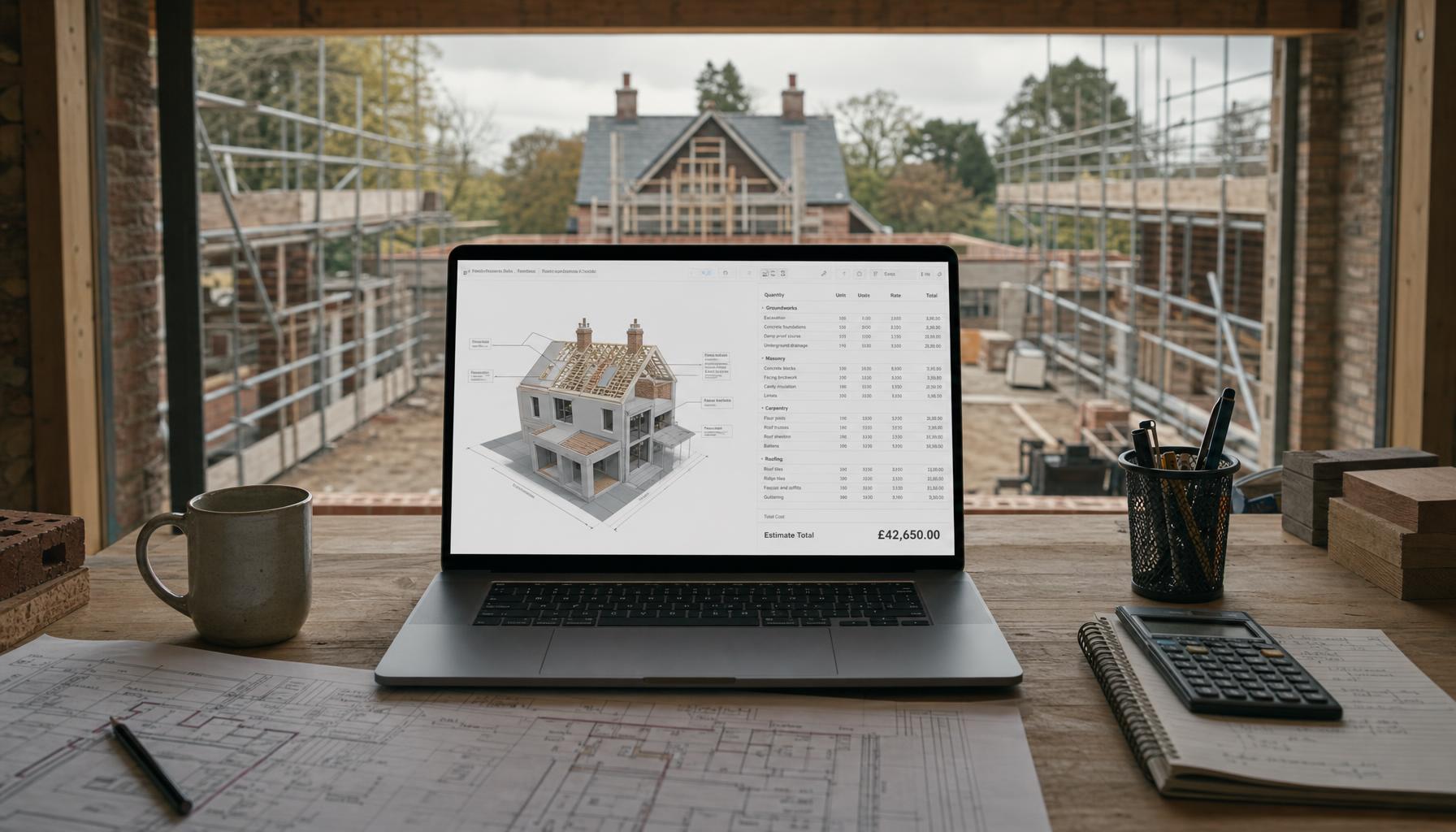
The quote that was right when you wrote it — and wrong by the time you started
You priced the extension job on a Tuesday. Materials, labour, skip hire, a bit of contingency — all sensible, all checked against what you paid last time. The client sat on it for three weeks while they argued with their partner about the kitchen layout. By the time they rang back to say “yes, let’s go,” your timber merchant had put prices up again and your labourer wanted more per hour than you’d budgeted.
Sound familiar? It should. GOV.UK’s own material price index for “All Work” was up 6.0% year-on-year as of June 2026, following a 5.4% rise in May and 3.2% in April — prices aren’t just high, they’re actively moving month to month. And labour costs aren’t sitting still either: the National Living Wage jumped 6.7% to £12.21 an hour in April 2025, which pushes up every day rate you’ve built a quote around. If your estimate is more than a few weeks old, there’s a decent chance it’s already wrong.
This is exactly the problem building estimating software is meant to solve — and it’s why more small UK building firms are ditching the spreadsheet for something with live pricing baked in.
Why a spreadsheet isn’t good enough any more
We get it. A spreadsheet is free, you built it yourself, and it’s done fine for years. But “fine” isn’t the bar when margins are this tight. On thin margins, one missed line item — skip hire, plant hire, prelims, a forgotten delivery charge — doesn’t dent your profit. It can wipe out the whole job.
A static rate card in a spreadsheet doesn’t know your timber went up last week. Construction cost estimating software that pulls live pricing from merchants like Jewson, Travis Perkins and Selco does. That’s not a nice-to-have feature any more — it’s the difference between a quote that protects your margin and one that quietly erodes it between the site visit and the start date.
There’s a workforce angle too. CITB’s own Workforce Outlook says the industry needs roughly 47,860 extra workers a year through 2029 — nearly 293,300 in total. The FMB/CIOB H2 2025 State of Trade survey backs this up on the ground: SME builders report continued growth in workload, but almost half say job delays are linked to a shortage of skilled tradespeople, and a separate FMB/CIOB survey found 72% of small and medium firms struggling to find skilled trades, up from 61% just six months earlier. Translation: you’re not hiring a dedicated estimator any time soon. Whatever gets your quotes out the door needs to do that job for you.
Speed to quote is the actual competitive weapon
Here’s the bit most estimating tool marketing skips over: research cited by the FMB shows homeowners typically ring 3 to 5 builders for any given job — and the first professional-looking quote often wins, even when it isn’t the cheapest. Not the best price. The first one that lands, properly itemised, while the other four builders are still scribbling numbers on the back of an invoice.
Picture the scenario: a homeowner calls about a loft conversion on a Monday morning. You visit Tuesday. If you’re back at your van typing figures into a phone and a professional, branded quote lands in their inbox by Tuesday evening, you’re the builder who looked like they had their act together. If it takes you until the following Monday because you’re doing the maths after the kids are in bed, someone else has probably already signed.
That speed matters because win rates in this trade are genuinely poor for most firms — a 2024 survey found UK builders typically win only 40-50% of the bids they enter, while the best-organised outfits hit 65%+. Closing that gap on even a handful of extra jobs a year covers whatever you’re paying for software many times over. That’s the ROI conversation worth having before you even look at feature lists.
What UK builders are actually paying (in £, not $)
Most of what ranks online for “building estimating software” is written for American home builders — dollars, US suppliers, no VAT, no CIS. None of it tells you what this actually costs a five-person UK outfit. So here’s the real picture:
- Free tier / very small jobs — fine for the odd one-off quote, but you’ll outgrow it fast if you’re quoting weekly.
- Around £40/month — solo and small-trade tools like EasyEstimate, which has a Professional plan at £39.99/month and pulls live merchant pricing straight into client-ready estimates.
- £45-£120 per user/month — the typical cloud estimating suite band for small contractors, per industry pricing surveys, sometimes with onboarding fees of £300-£1,500 on top.
- £999+VAT/year — desktop-first UK suites like EstimatorXpress, which claims over 10,000 builders and developers use it and carries a 5-star Trustpilot rating.
On the compliance/certification software side (a different but related category), tools like Clik Compliance run from £20/user/month for entry-level certificate templates up to £25/user/month for the Advanced tier — worth knowing if your firm also handles CP12 or Gas Safe paperwork alongside quoting. And if you want job management bolted on rather than pure estimating, Tradify prices per user from £34 to £44/month depending on tier.
None of these numbers are wrong exactly — they’re just built for a different job than what a small UK builder actually needs day to day: quote fast, quote accurately, and don’t lose the job to the builder who replied first.
Where Hero AI fits — quoting that doesn’t need a spreadsheet or a specialist
We built Hero365 because most 1-15 person building firms don’t want another piece of software to learn. They want the quote done. Hero AI drafts a Good/Better/Best estimate from a voice note in under a minute — you walk the site, talk through what you’re seeing, and a properly structured, itemised quote is ready to send before you’re back in the van. No spreadsheet, no rate card that’s three months stale, no days of phone tag while the client waits and rings someone else instead.
It also chases the quotes that go quiet, follows up automatically so you’re not the one remembering to call back, and keeps the invoicing side moving once the job’s won — which matters given how much cash small building firms have sitting in unpaid invoices at any given time. We’ve written more on the labour side of this in our guide to construction scheduler software, if getting the crew booked once you’ve won the job is your next headache.
Hero AI starts at £19.99/month for the AI Concierge tier, with Growth at £119/month and Scale at £289/month for firms that need more built out — no per-seat pricing, no onboarding fee, no demo call required. You hire it by downloading the app.
The real question to ask before you pick anything
Not “which building estimating software has the most features” — ask “which one gets a professional quote in front of the client before four other builders beat me to it, without pricing off numbers that are already out of date.” That’s the actual job. Material prices are moving 6% a year, day rates are moving with the Living Wage, and your best estimator is probably you, on-site, with fifteen minutes before the next job.
If you want to see how Hero AI handles quoting alongside the rest of the admin — calls, invoicing, follow-up — have a look at our free tools or head straight to download the Hero365 app and try it on your next quote.