HVAC Field Service Software: How AI Dispatch Keeps Engineers Moving on a Heatwave Tuesday
A heatwave Tuesday can triple your call volume before lunch — and no amount of hiring fixes that. Here's how AI dispatch software keeps HVAC engineers moving, answers the calls you'd otherwise miss, and what it actually costs versus a missed emergency job.
The phone doesn’t ring once on a heatwave Tuesday — it doesn’t stop
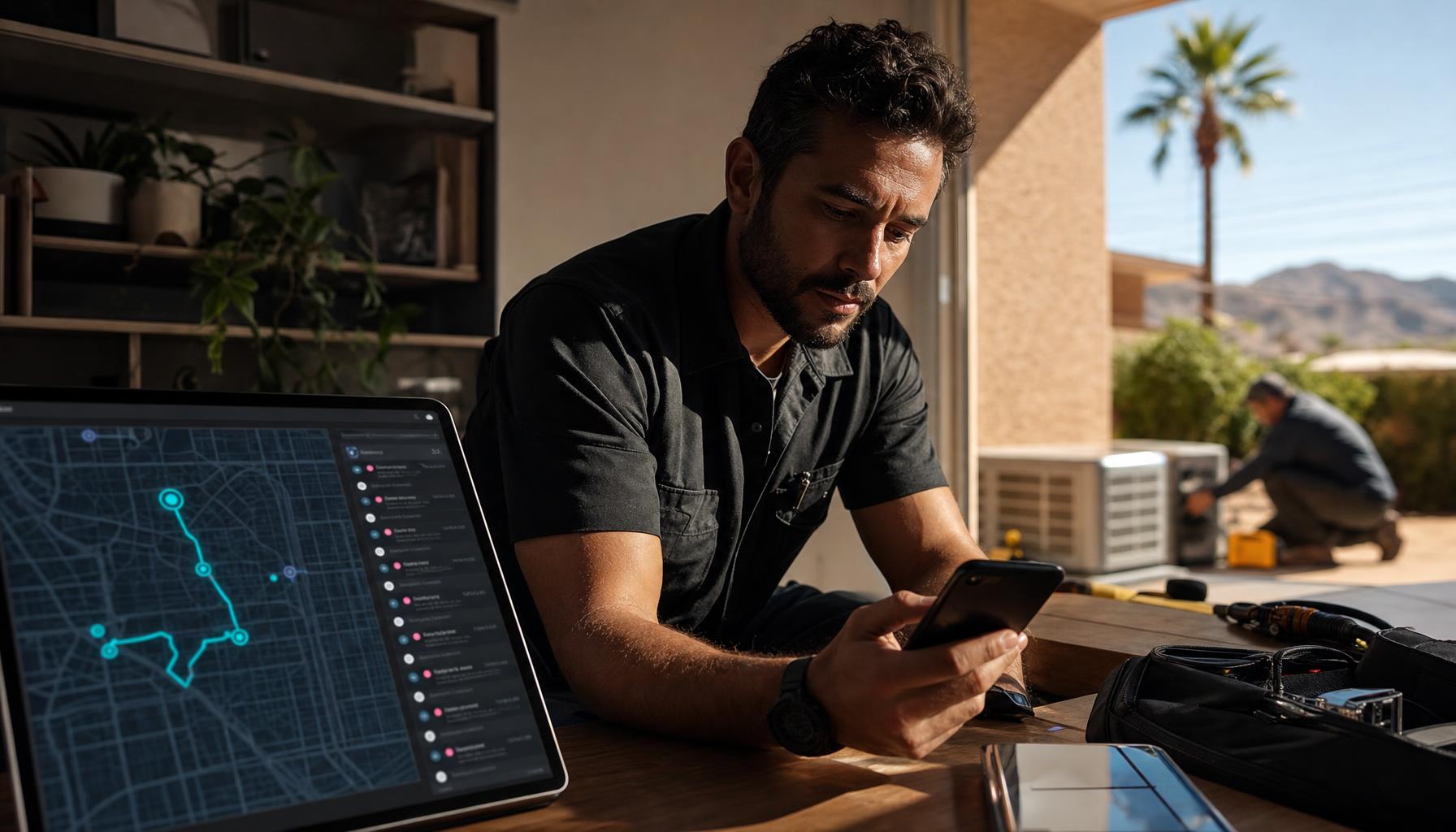
Picture it. It’s 34°C by 9am, the third day of a proper heatwave, and your office line has been going since 7:15. Every call is the same: “my system’s packed up, can you come today?” By lunchtime you’ve got eleven jobs on a board built for six trucks, two engineers stuck in traffic on the A1 because the diary sent them across town and back, and a voicemail box filling up with people who’ll ring your competitor the second you don’t pick up.
That’s not a bad day. That’s the new normal. US telematics data from Samsara found HVAC fleets ran 14 more trips per vehicle in June 2025 than June 2024 — and in one hard-hit local market during a single June heatwave, trips per vehicle spiked 374% year-on-year. The same pattern shows up in call data: off-hours call share for residential HVAC shops nearly doubled seasonally — 14.1% of inbound calls landed outside business hours in June versus 9.8% in October, a 45% relative swing. Your board doesn’t fill up gradually on a heatwave day. It fills up in the first two hours.
This is exactly the gap most HVAC field service software content skips over. Vendor pages talk about “route optimisation” and “20 hours saved a week” in the abstract. Nobody tells you what actually happens to a 5-truck shop when the call volume triples between breakfast and lunch. That’s what we want to walk through here.
What a 3-4x call spike actually does to your dispatch board
Every trade body echoes the same headline warning about capacity — the widely cited industry figure is roughly 110,000 missing HVAC technicians across the sector. You can’t hire your way out of a heatwave Tuesday. There’s no agency you can ring at 8am for two spare gas engineers. The only lever left is getting more finished jobs out of the trucks you’ve already got — and that’s a dispatching problem, not a staffing one.
Here’s the bit nobody says out loud: a heatwave doesn’t spread failures evenly across your patch. It clusters them. Grid data backs this up — the US grid hit fresh peak demand records on several days in July 2025, including a new ERCOT peak of 91 GW on 22 July, with sustained high temperatures driving persistently high load. Voltage sag and brownouts during those peaks are exactly when capacitors and compressors give up — and they tend to give up in the same streets, on the same feeder, on the same afternoon. A dispatch board that assigns jobs in the order calls come in (which is still how most whiteboards and basic diaries work) sends your van across town and back four times instead of clearing a whole postcode in one loop.
AI dispatch software that clusters by location and skill, rather than call order, completes more jobs per truck on exactly this kind of day. Industry benchmarking on AI-driven scheduling shows operators reporting 20-35% reductions in total drive time, with dispatchers getting back 8-12 hours a week they’d otherwise spend manually re-juggling the diary. On a normal Tuesday that’s a nice-to-have. On a heatwave Tuesday, it’s the difference between finishing at 5pm with eleven jobs done and finishing at 9pm with eight done and three angry customers.
Every unanswered call is a no-show competitor booking
Here’s the number that should worry you more than drive time. Off-hours calls — the ones that come in before 8am or after 6pm — are disproportionately the highest-value jobs of the year. A dead AC unit at 7am on the hottest day of the summer isn’t a call that waits for a callback. It’s a call that goes to whoever answers first. And with off-hours share nearly doubling in summer, that’s a lot of your highest-ticket, least price-sensitive work sitting in a voicemail box while you’re up a loft on a scheduled service.
The scale of that gap is measurable — research cited around the recent wave of AI receptionist launches in the trade found 96% of home service consumers say response time influences their purchasing decision. That’s the whole game on a heatwave Tuesday: the shop that picks up first gets the £800 emergency call-out; the shop whose phone rings out gets nothing. It’s why field service vendors right across the market — from certification tools like Clik Compliance to job management platforms like Tradify — are all being pulled towards the same answer: cover the phone every hour it might ring, not just the hours your office is staffed.
None of this is theoretical for a UK gas engineer. Same heat, same call pattern, same grid strain in a warm spell — and the same maths: every missed call on the hottest day of the year is a booking your competitor’s answering service just took instead. This is exactly the scenario we walked through in our HVAC scheduling software guide for a heatwave Tuesday — worth a read if you want the full run-through of one specific day, hour by hour.
What Hero AI actually does at 7am when the board fills up before lunch
We built Hero AI to be the front desk and dispatcher you can’t afford to hire two of just for June through August. Here’s what that looks like on the ground:
- Answers every call, 24/7 — including the 7am ones before your office opens and the 9pm ones after your last engineer’s clocked off. No more voicemail box quietly filling up with jobs your competitor picks up instead.
- Books straight onto the board — no scribbled notes, no “I’ll call you back with a slot.” The customer gets a time. You get a booked job.
- Routes by postcode and skill, not call order — so when three units go down on the same street during a brownout, Hero AI clusters them into one loop instead of sending an engineer criss-crossing your patch.
- Cuts drive time by 10-15% — which on a day where every minute counts is the difference between eight completed jobs and eleven.
- Drafts the Good/Better/Best estimate from a quick voice note on the way to the next job, so you’re not doing paperwork at 10pm instead of sleeping before day two of the heatwave.
You don’t need a demo call or an onboarding project to get any of this running. Hero AI is hired the same way you’d hire anyone else who’s useful — download the app and it’s answering calls the same day.
What it costs versus what a missed call costs
This is where most of the vendor pages on this topic go quiet, because most of them are quote-only. Clik Compliance, aimed more at certification than dispatch, publishes an Entry tier at £20/user/month for up to 30 certificates. Tradify — a straightforward job management tool many small HVAC shops already know — publishes Lite at £34, Pro at £37, and Plus at £44 per user, per month. Those are all per-seat prices, which means every engineer you take on raises your software bill on top of their wages.
Hero AI starts at £19.99/month for the AI Concierge tier — one flat price, not per engineer, covering the AI answering and booking layer alone. Growth sits at £119/month and adds the dispatch and job-costing layer; Scale is £289/month for shops running a bigger fleet who want the full back office covered. Compare that to what one missed emergency call costs a five-truck shop on the hottest day of the year — an £800 job gone to a competitor because nobody picked up — and the maths isn’t close.
The heatwave isn’t going anywhere — neither should your calls
The field service software market is projected to grow from $5.1 billion to $9.17 billion by 2030, and vendors right across the trade — from compliance software to job management apps — have spent the back half of 2025 racing to add AI answering and dispatch features. That tells you something: this isn’t a gimmick, it’s where the whole trade is heading, and the shops sitting it out are the ones falling behind, not staying neutral.
You can’t add another engineer for the three weeks a year it’s 34°C outside. But you can make sure every call on that Tuesday gets answered, every job lands on the most efficient route, and your evening’s spent with your feet up instead of chasing paperwork. If you want to see what that actually looks like on your patch, have a browse through our free tools or just download the app and let Hero AI answer the next call.