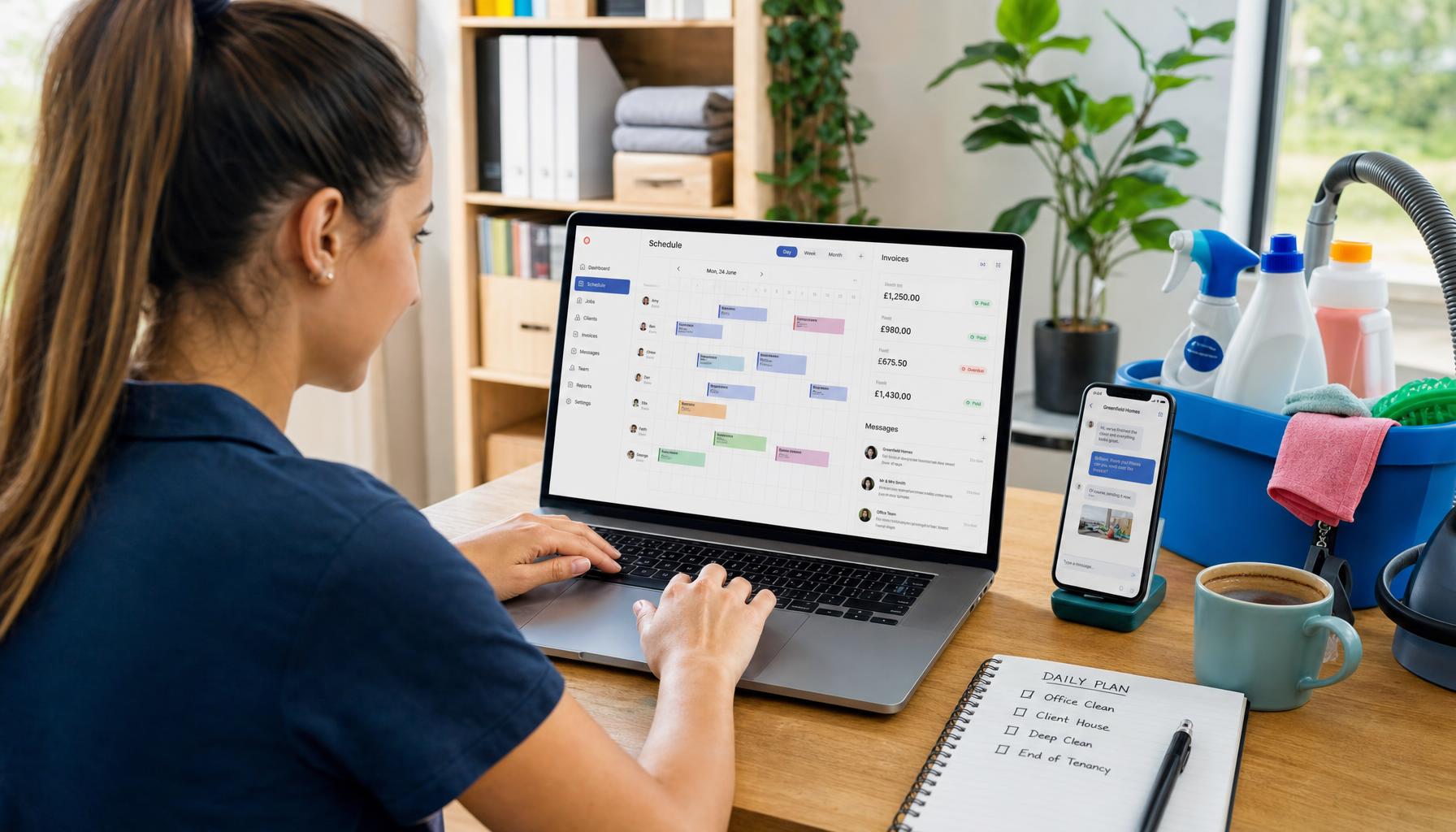
HVAC Scheduling Software UK: A Heat-Wave Tuesday With an AI Dispatcher
It's 31°C, your phone won't stop ringing, and every engineer in the postcode is booked solid. Here's what HVAC scheduling software actually does on the busiest day of the year — and what changes when an AI dispatcher is running your board instead of a whiteboard.

It’s 7:40am. The Met Office said 31°C by lunchtime. You’ve had four missed calls before you’ve even had your coffee, and your phone’s already buzzing again on the passenger seat. Every air con and heat pump engineer in a 20-mile radius is about to have the same Tuesday you are.
This is the day HVAC scheduling software either earns its keep or falls over completely. And if you’re still running the board off a whiteboard, a shared calendar, or “whoever answers the phone first gets the job,” a heat-wave Tuesday is where it shows.
Let’s walk through what that day actually looks like when an AI dispatcher is running your diary instead of you.
Why HVAC Scheduling Turns Into Chaos on the Hottest Day of the Year
Here’s the thing about heat waves — they don’t spread demand out, they compress it. Every landlord with a dead split system calls at once. Every care home with a failed AHU calls at once. Your existing customers with a system that’s “just making a funny noise” suddenly decide today’s the day to sort it, because today it’s unbearable.
Normal HVAC scheduling software just gives you a digital version of the same problem: a grid that fills up in the order calls land, not in the order they matter. A blocked filter on a domestic split gets the same slot priority as a commercial chiller down at a food storage unit, purely because that caller got through first.
Meanwhile you’re up a loft somewhere with no signal, your apprentice is driving, and the phone rings out four, five, six times. Each ring-out is a customer who hangs up and calls the next engineer in their search results. On an ordinary Tuesday that’s annoying. On a heat-wave Tuesday, when everyone’s stretched, that’s real money walking straight to a competitor.
What Actually Changes With an AI Dispatcher Running the Board
Picture the same Tuesday, but Hero AI is answering every call that comes in — the ones you can’t get to, the ones that land while you’re up a ladder, the ones at 6:15am from someone whose AC’s been off all night with kids in the house.
Hero AI picks up, asks the right questions (make of unit, is it cooling at all, is anyone vulnerable in the property), and books straight onto your live schedule based on urgency and location — not on who dialled first. A no-cooling call for an elderly resident goes ahead of a routine service call, automatically. A commercial unit serving a server room gets flagged as priority without you having to triage it yourself between jobs.
By 9am your board looks nothing like the free-for-all it would’ve been otherwise. It’s sorted by what actually needs doing first, and every slot that’s filled is filled with a real job, real address, real contact details — no scrap of paper, no “I’ll write it down when I get back to the van.”
Most small HVAC outfits miss around 40% of after-hours calls on a normal week. Multiply that by heat-wave demand and you can see how much work — and how many one-star “never answered the phone” reviews — you’re leaving on the table without something picking up.
Routing: Getting to the Right Job Without Burning the Day in Traffic
Heat-wave Tuesday isn’t just about answering the phone. It’s about not spending your afternoon stuck on the ring road because the day got booked geographically backwards — job one in the north, job two thirty minutes south, job three back near job one again.
Hero AI routes the day as it fills, not after. New emergency call comes in near where you already are? It slots in, doesn’t get bolted onto the end of the list regardless of postcode. That’s the difference between an HVAC scheduling app that just stores appointments and one that actually dispatches. Contractors using Hero AI to route the day typically cut drive time by 10-15% — on a day like this, that’s an extra job or two you can actually reach before the heat drops off in the evening.
We covered the general mechanics of this in our guide comparing job scheduling programs — the short version is the whiteboard loses every time demand spikes, because a whiteboard can’t re-sort itself in real time and you can.
Compliance Doesn’t Stop Because It’s Hot
Here’s what a lot of HVAC business scheduling software gets wrong for the UK market — it treats every job as a plain appointment. But if you’re a Gas Safe registered engineer and today’s ninety-degree emergency turns out to be a boiler-linked system needing attention, or a landlord’s asking for a CP12 while you’re there, that paperwork still needs producing, correctly, on the day.
Hero AI keeps the certification side moving alongside the job itself — the record’s tied to the visit, not a separate form you fill in back at the yard at 9pm when you can’t remember which flat had the corroded flue. If certificates are your main headache day-to-day rather than the dispatch side, we’ve gone deeper on that specifically in our piece on gas safety certificate software vs standalone CP12 apps. Worth a read if compliance is what’s actually eating your evenings, not just scheduling.
What This Costs vs What Else Is Out There
A lot of UK HVAC scheduling software is priced per user per month, which sounds fine until you hire your third engineer and your software bill jumps with them. Tradify, for instance, runs £34-£44 per user per month depending on the tier — reasonable for job management, but it’s a job diary, not something answering your phone for you. Clik Compliance sits at £20-£25 per user per month and is built specifically around producing certificates, which is useful if certification volume is your bottleneck, but again — it’s not picking up the phone at 6am or working out who to send where.
Hero AI starts at £19.99/month (or £199.99/year, about two months free) for the AI Concierge that answers and books your calls around the clock. Growth and Scale tiers add the dispatching, routing and invoicing layers as you need them. No per-seat pricing, no charge that climbs every time you hire — you download the app and hire the AI staff, same as you’d hire a person, minus the recruitment headache. Full details are on the UK pricing page.
The Rest of the Day
By mid-afternoon on a normal heat-wave Tuesday without help, you’re behind, stressed, and fielding angry calls from people who’ve been waiting since 8am with no update. With Hero AI running the desk, those same customers get an automatic update when you’re running late, and a follow-up message after the job’s done — catching the “actually it’s still not cooling properly” comment before it becomes a one-star review instead of a callback booked for tomorrow morning.
That’s really the whole pitch. It’s not that the software works harder than you on the hottest day of the year — it’s that it works while you’re up the ladder, so the phone isn’t a threat every time it rings.
If you want to see what your next heat-wave Tuesday looks like with someone else answering the phone, download the Hero365 app and hire Hero AI — or have a look at how it handles the dispatch side specifically first.