R-410A Just Got 60% More Expensive: What to Charge for Legacy AC Repairs Right Now
R-410A wholesale prices just jumped 60% in the UK — a preview of what's already squeezing US contractors. Here's how to reprice legacy AC repairs, capture the A2L labor premium, and turn the refrigerant cost gap into a replacement pitch.
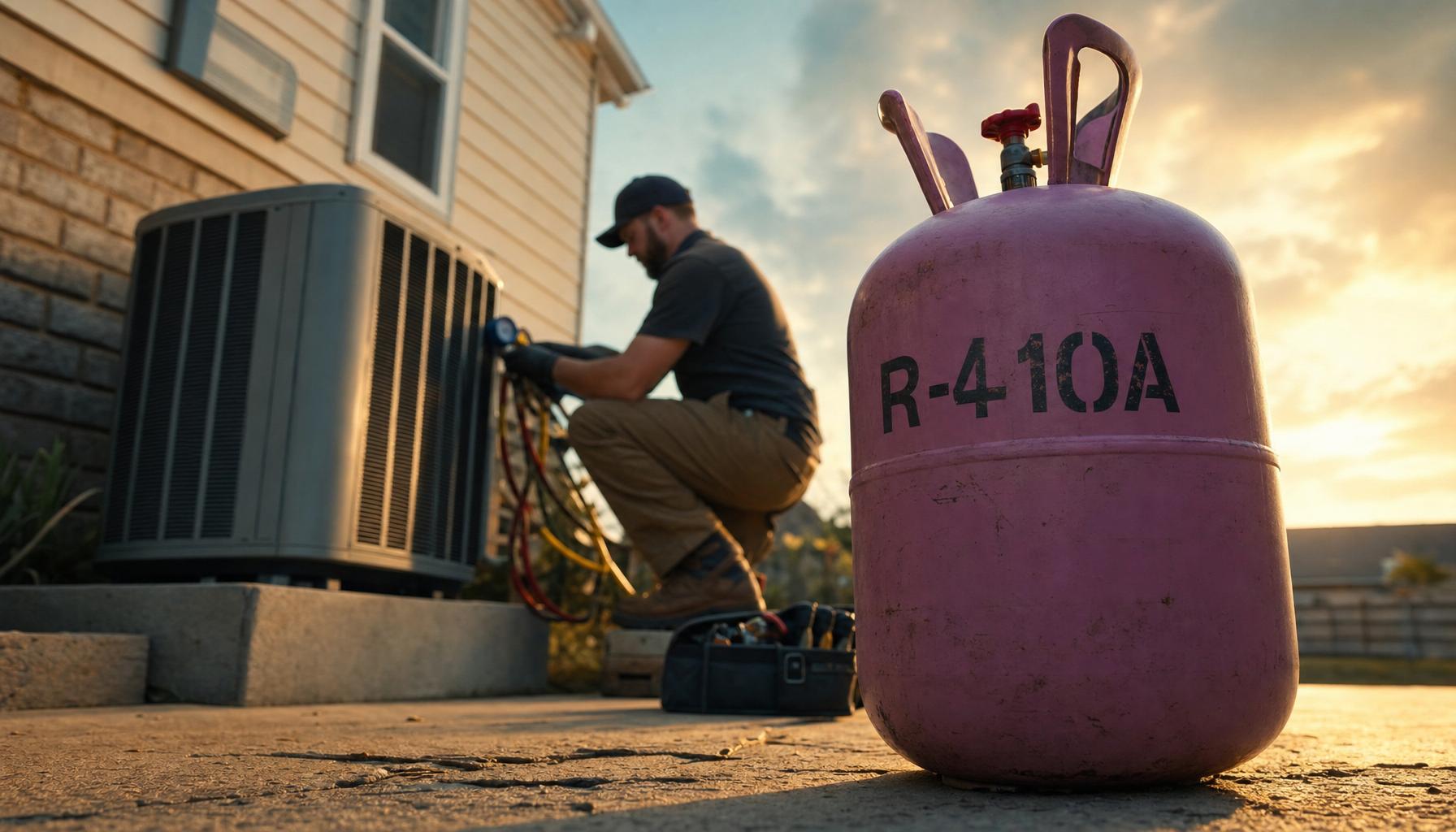
Your R-410A jug just got a lot more expensive, and if your price sheet hasn’t caught up yet, you’re paying your customers to do their AC recharge.
Here’s what happened. Beijer Ref UK — the UK’s largest refrigeration and AC wholesaler — just announced a 60% wholesale price increase on R-410A, effective May 20, 2026 (R-407C jumped 60% too, R-134a climbed 35%, R-32 rose 30%). That’s a UK number. But the mechanics behind it are the exact same ones squeezing US contractors right now, and this is your warning shot.
The EPA’s AIM Act already cut US HFC production allowances to 60% of baseline back in 2024. The next cut — down to 30% of baseline — hits January 1, 2029, and it’s expected to be the single most disruptive price event of the entire phasedown. If a 60% jump in the UK feels sudden, that’s a preview of what tightening supply caps do when they finally bite. R-410A price increase 2026 isn’t a headline you can skim past — it’s a repricing job you need to do this week.
Why R-410A Price Increase 2026 Isn’t Going Away
Let’s get the numbers straight, because they’ve moved fast and most shops are still quoting off an old sheet.
As of January 1, 2025, manufacturers can’t produce or import new R-410A residential and light commercial equipment anymore — servicing existing systems with R-410A is still fully legal, but the supply of virgin refrigerant feeding that legal servicing market is shrinking on purpose. That’s the whole point of the phasedown.
The result: R-410A prices have climbed 40-60% since that January 2025 cutoff, with homeowners now paying $50-$90 per pound installed — some emergency calls pushing past $100/lb — versus roughly $40/lb or less in early 2024. On the wholesale side, EPA-certified contractors are paying $16-$20 per pound for virgin R-410A, with a 25-lb cylinder running $400-$500+. Five years ago that same pound cost $4-$8.
So if you’re still flat-rating a recharge off a 2023 price list, you’re eating margin on every single legacy service call. Rebuild your R-410A repair price book monthly — not annually — and itemize refrigerant cost as its own line item on every invoice. Let customers see the jug price move with the market instead of absorbing it silently and wondering why your margins keep shrinking.
The R-454B Labor Premium Is Real Money on the Table
Here’s the flip side, and it’s the part most small shops haven’t priced in yet.
R-454B became mandatory for new residential HVAC installs on January 1, 2026 under the EPA’s AIM Act Technology Transitions Rule. It’s not optional anymore — R-454B is now 100% of new Trane and Carrier residential shipments. If your trucks aren’t A2L-equipped, you’re either turning away new-install work or underbilling it.
But shops that got ahead of the transition are charging for the trouble. A2L-certified, A2L-equipped contractors are billing labor at 18-30% above pre-transition rates on R-454B installs and heat-pump-capable systems. On a $12,000 install, that premium can equal roughly $500 of pure incremental margin — run twelve of those a month and you’re recovering about $72,000 a year against a one-time $3,000-$8,000 per-truck retool.
Why can they charge more? Because R-454B is mildly flammable (classified A2L under ASHRAE Standard 34) with a global warming potential of about 466 — 78% lower than R-410A’s 2,088 GWP. Handling it correctly requires new recovery machines, manifold gauges, leak detectors, and certified technicians. That’s not marketing fluff — it’s real risk and real cost, and customers understand paying for it when it’s explained plainly.
The catch: A fully A2L-equipped kit runs $2,500-$4,500 per technician, plus $300-$800 a year in ongoing training. And the 2025 Contractor of the Future Study — a Fall 2025 survey of 1,000 HVAC contractors run with ACCA — ranked A2L readiness the #1 technical training gap in the country. Lack of clarity on codes and the cost of new tools were the top two concerns. Translation: most of your competitors are stuck exactly where you might be. Close that gap first and the A2L labor premium is yours to keep.
The Technician Shortage Makes This Worse, Not Better
You can’t hire your way out of this one easily. The industry is short roughly 110,000 technicians nationwide, with about 25,000 leaving the workforce every year and five techs retiring for every two entering the trade. Every shop in your market is competing for the same shrinking pool of A2L-trained labor.
That makes certifying your existing crew the faster lever to pull. Get your current techs Section 608 and A2L certified now, before the shop down the street does it first and starts winning every R-454B bid in town.
Turning the R-410A vs. R-454B Gap Into a Replacement Pitch
Here’s where the numbers actually help you close bigger jobs. On an aging 3-4 ton system needing a full recharge at today’s R-410A pricing, the refrigerant alone can run $480-$1,000+. That’s now a meaningful fraction of a new system’s price — and it’s a legitimate, numbers-backed reason to steer a customer with a 10+ year-old unit toward replacement instead of another recharge.
Yes, R-454B equipment still costs more upfront — 15-30% more than equivalent R-410A gear today (a 3-ton system running $5,000-$7,000 vs. $4,000-$5,500), though that gap is expected to narrow to 5-15% by 2028 as production scales up. Lay both numbers side by side for the customer: keep recharging an old system at $50-$90/lb with no end date, or put that money toward a system that won’t need R-410A again. Installed AC prices overall are already up 10-12% since mid-2024 from this transition alone — customers are going to pay more either way. Your job is showing them where that money works best for them.
Don’t Let Admin Work Eat the Margin You Just Recovered
Repricing your repair book and adding an A2L labor line only pays off if it actually makes it onto every invoice, every estimate, every time — not just the jobs you remember to double-check. That’s exactly the kind of detail that slips when you’re juggling calls, dispatch, and a truck full of parts.
Hero AI drafts Good/Better/Best estimates from a voice note in under a minute, so your updated R-410A repair pricing and R-454B labor premium get built into every quote automatically — no more digging up last year’s price sheet on a job site. It also answers your after-hours calls (most small shops miss about 40% of them) and books the job straight onto your schedule, so the aging-system replacement conversation actually happens instead of going to voicemail. We walked through more of this in our guide to automating HVAC scheduling, dispatch, and follow-ups.
If refrigerant tracking and EPA compliance paperwork is part of what’s slowing your repricing down, we also covered how to track refrigerant usage and stay EPA compliant without spreadsheets.
Reprice This Week, Not Next Quarter
The 60% jump at Beijer Ref UK is a preview, not an isolated incident — the same supply mechanics are already squeezing US contractors, and the 2029 AIM Act step-down is coming whether your price book is ready or not. Update your R-410A repair pricing now, price your A2L labor premium explicitly instead of absorbing it, and use the cost gap to move aging systems toward replacement while the math is on your side.
You can check what your own numbers look like with our cost calculator, or see how Hero AI — starting at $19.99/month — can get every one of your estimates repriced automatically. Hire your AI staff today and stop bleeding margin on every legacy recharge you write up.